Reflections on the ‘Veenweide Atelier: Design for a Sunken Marsh’
- Sep 5, 2025
- 6 min read
The ‘Veenweide Atelier: Design for a Sunken Marsh’ is an exhibition on display at the Fries Museum until the 26th of October 2025. The Fries Museum is located in Leeuwarden, the provincial capital of Friesland.

Friesland (or Fryslân) is a region in the north of the Netherlands, largely comprised of lowland peat landscapes used for pasture. Subsidence resulting from the consolidation and oxidation of peat is having a major impact on the landscape (Nieuwenhuis & Schokking, 1997), raising questions about its future, particularly as degrading peat is a source of CO2 emissions. ‘Veenweide Atelier: Design for a Sunken Marsh’, curated by designer Henriëtte Waal, showcases how designers can collaborate with stakeholders and explore alternative land use practices that address the landscape challenges facing peat meadows (Ontwerpers, 2025). The exhibition displays a range of physical artefacts produced by the Atelier that are sensitive to the peatland ecology: textiles printed with pigments, created by fermenting bacteria from soil on dairy farms; architectural renders and models imagining adaptive retrofit uses for the ‘’t Kathûs’ farmhouse that unite people and the landscape; material samples of boards made from ‘Lisdodde’ (Typha latifolia) and ‘Riet’ (Phragmites australis); a series of furniture pieces made from paper clad board derived from Typha latifolia.


Of particular personal interest was the furniture, as paludiculture is a theme I have previously explored in my work with the Cambridgeshire Fens (Mitchell, 2025). Paludiculture is the practice of farming degraded peat with an elevated water table to grow profitable crops (Ross, 2024). It has the potential to reduce the degradation of peat soils and CO2 emissions whilst still cultivating the land and supporting fen biodiversity. It’s understood that paludiculture can support wetland-specialist species characteristic of lowland peatlands (Taylor & Stockdale, 2025), although it remains an agricultural approach yet to be implemented beyond trials. The panels used to construct the furniture in the exhibition were made by designer Tjeerd Veenhoven from Typha latifolia and wrapped in paper created from waste offcuts by De Schoolmeester in North Holland. Furniture designer Friso Wiersma then transformed the sheets into furniture that represents functional, scalable uses of the materials and the commercial potential of paludiculture to large retailers (Ontwerpers, 2025).
Wiersma’s design approach confronts the antagonism between craft and production, acknowledging the difficulties of working in a local context but at a landscape scale. In a video played alongside the furniture, Wiersma highlights the need for compromise through engaging with industrial production processes to achieve significant ecological change. The need for these land use approaches to function at a commercial scale is reflected in the style of the furniture. The overall aesthetic shares similarities with IKEA’s functional modernist style, demonstrating how markets for paludicultural materials could be established by working with large-scale furniture manufacturers and retailers. The softened, cigar-like profile of many of the pieces within the collection is informed by the shape of Typha seed heads. Paper foils have been applied to the Typha board, which also mimics the way that mass-manufactured furniture made from materials like MDF or chipboard is conditioned. In contrast with these big, system-level influences is the name of the project. The series is called ‘Doerebout’, the Stadsfries dialectal name for Typha Latifolia, which is spoken in parts of Friesland. The incorporation of local references is a further reflection of the dialogue between craft and production, working locally and in place, but with scaled, commercially viable production systems. The use of local materials and styling in the modern tradition, with subtle nods to the Typha, could be used to describe the furniture collection as an example of critical regionalism, a term used in architecture to describe the tension between universal modernism and the unique features of rooted culture (Frampton, 1983).

The concepts of scale, craft, and production are familiar themes when navigating the field of regenerative design. Seeing the Veenweide Atelier’s work and being able to contextualise it against both the landscapes of Friesland and the Fens also generates new lines of enquiry about the role of regionalism and how paludiculture might be expressed through design at a more local level once established. Asquith & Vellinga (2006) define vernacular architecture etymologically as “native or unique to a specific place, produced without the need for imported components and processes, and possibly built by the individuals who occupy it”. Vernacular manifests itself through materiality and its use in ways that are unique to a place; such an approach roots design within a local context and the surrounding natural environment (Rice, 2003). Whilst its origins lie in architecture, vernacular is referred to within other design disciplines, such as typography and furniture design. Although informed by tradition, a vernacular approach isn’t at odds with modernity and can benefit from contemporary technology, skills, and knowledge to maintain cultural and environmental relevance (Asquith & Vellinga, 2006). Paludiculture may be a potential driver of new vernacular styles, combining heritage with innovation through form-giving, material design, and manufacture for wetland regions. Utilising novel paludicultural crops that are prevalent within local ecologies could also root future design work in place and differentiate localities both regionally and internationally. Current European paludicultural trials focus largely on Typha latifolia, which might lead to a more generic wetland design typology emerging rather than more specific, ecological responses.
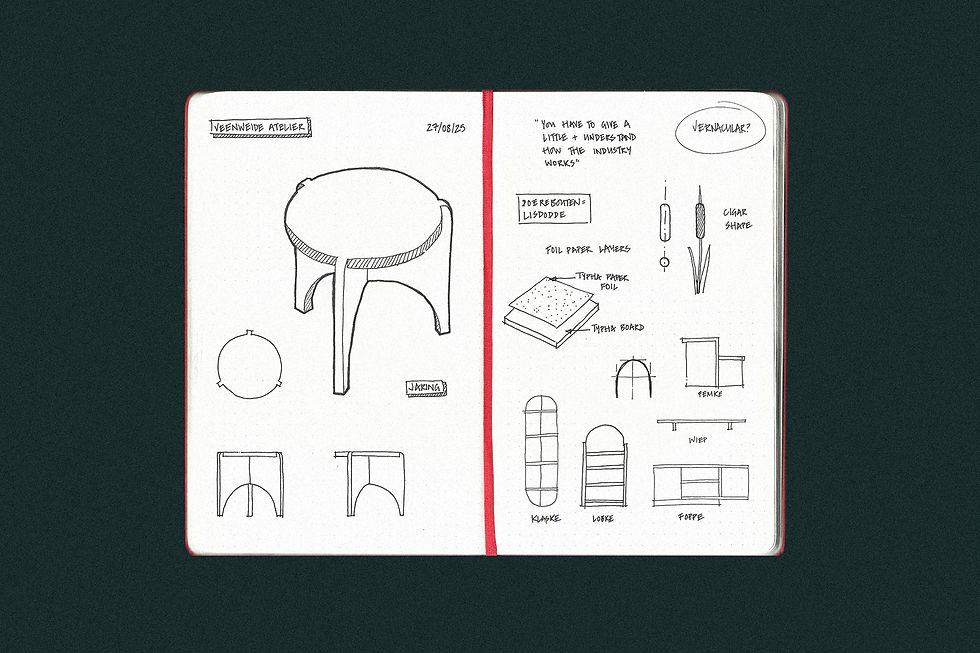
The idea of a new Fenland design vernacular as a response to paludiculture is an interesting one, not just in terms of material use or production method, but in the artefacts themselves. The Fens have a rich material culture of specific tools and objects for interacting with the peatland and its associated species. Future design engagement offers ways to continue evolving that material culture to reflect changing attitudes to the lowland peat landscape. Vernacular design also brings cultural and economic value to an area, contributing to a sense of identity that’s increasingly being defined by global systems. Through draining its once ecologically abundant wetlands, the Fens has instead chosen an identity defined by productive farming systems and a lack of water (Irvine, 2015). A new Fenland vernacular presents an opportunity to celebrate fen biodiversity and deepen connections to nature whilst establishing markets for profitable crops.
The Veenweide Atelier’s work and the formation of an experimental design lab in Friesland establish a precedent for engaging with design and lowland peat ecosystems at a regional level. The success of their work and the exhibition sets an example for how design can be utilised within the Fens to challenge some of the cultural and commercial market barriers to paludicultural farming. The artefacts produced demonstrate how design can generate value in ways that have a minimal impact on the health of peat meadows. Reflecting on the work has also led me to consider further research opportunities, primarily how new vernaculars might form from paludiculture, in what ways they will distinguish themselves from one another, and the role design or place has in this.
References
Asquith, L. and Vellinga, M. (eds.) (2006) Vernacular architecture in the twenty-first century: Theory, education and Practice. London: Taylor & Francis.
Frampton, K. (1983) ‘Prospects for a Critical Regionalism’, Perspecta, 20, pp. 147–162. doi:10.2307/1567071.
Irvine, R.D.G. (2015) East Anglian fenland: water, the work of imagination, and the creation of value. in K Hastrup & F Hastrup (eds), Waterworlds: Anthropology in Fluid Environments. Berghahn, pp. 23-45.
Mitchell, L. (2025) From the fens, with the Fens, for the fens, Lucy Mitchell. Available at: https://www.lucy-mitchell.com/portfolio-collections/my-portfolio/from-the-fens (Accessed: 05 September 2025).
Nieuwenhuis, H.S. and Schokking, F. (1997) ‘Land subsidence in drained peat areas of the province of Friesland, the Netherlands’, Quarterly Journal of Engineering Geology, 30(1), pp. 37–48. doi:10.1144/gsl.qjegh.1997.030.p1.04.
Ontwerpers, B.H. (2025a) Doerebout, Arcadia. Available at: https://arcadia.frl/en/projecten/veenweideatelier/doerebout/ (Accessed: 05 September 2025).
Ontwerpers, B.H. (2025b) Henriëtte Waal, Arcadia. Available at: https://arcadia.frl/en/projecten/veenweideatelier/henriette-waal/ (Accessed: 05 September 2025).
Rice, M. (2003) Village buildings of Britain. London: Time Warner.
Ross, K. (2024) Potential for Greenhouse Gas Emission Savings from Paludiculture. Department for Environment, Food and Rural Affairs. doi:10.13140/RG.2.2.10310.59205.
Taylor N.G. & Stockdale E.A. (2025) Impacts of paludiculture on the natural environment: a scoping report. Report to Natural England. Paludiculture Exploration Fund Project CCN4. 81 pp. https://doi.org/10.17605/ OSF.IO/R2XFS
Comments